

Industries
Solutions
Capabilities
About
Insights
Industries
Solutions
Capabilities
About
Insights
The drug delivery industry depends on innovation, and keeping abreast of the latest trends can help us predict the future. We are in the privileged position of being at the center of many of the most exciting drug delivery devices developments and we have compiled the following top trends for 2022:
Countries around the world are still struggling to manage waves of Covid infections. The highly infectious Omicron variant has undone some of the progress made by vaccination campaigns in the wealthier economies. Nevertheless, the suffering and disruption brought by Covid has led to some profound changes and benefits for the healthcare industry, which we have coined “the Covid dividend.”
Before Covid, political leaders may have considered vaccine strategy primarily to be concerned with public health. However, the continuing threat of Covid is likely to remind them of the vital role healthcare plays in national security and economic welfare too. National governments and supranational organizations like the European Union seem to be announcing new vaccine procurement deals almost daily.
The US Vaccines National Strategic Plan (published on 19 January 2021) says that “there remains a significant need for new and improved vaccines and vaccination strategies, such as the development of new vaccines against vector-borne diseases, a more broadly protective universal influenza vaccine, and improved strategies for maternal immunization. Developing new vaccines includes modernizing the domestic [US] vaccine enterprise to be highly responsive, flexible, and scalable; improving capacity for agile and rapid responses to emerging influenza threats; and developing more broadly protective vaccines.”[1] Therefore we can be confident that funding into vaccine development, and the devices to deliver vaccines, will continue to be high for the foreseeable future.
Vaccines are not the only area of healthcare in great demand due to Covid and the risk of other pandemics. Diagnostics (point-of-care and laboratory), critical care equipment, and personal protective equipment are likely to benefit strongly from the Covid dividend too.
[1] https://www.hhs.gov/vaccines/vaccines-national-strategic-plan/index.html
Many categories of drug delivery device can be developed as either:
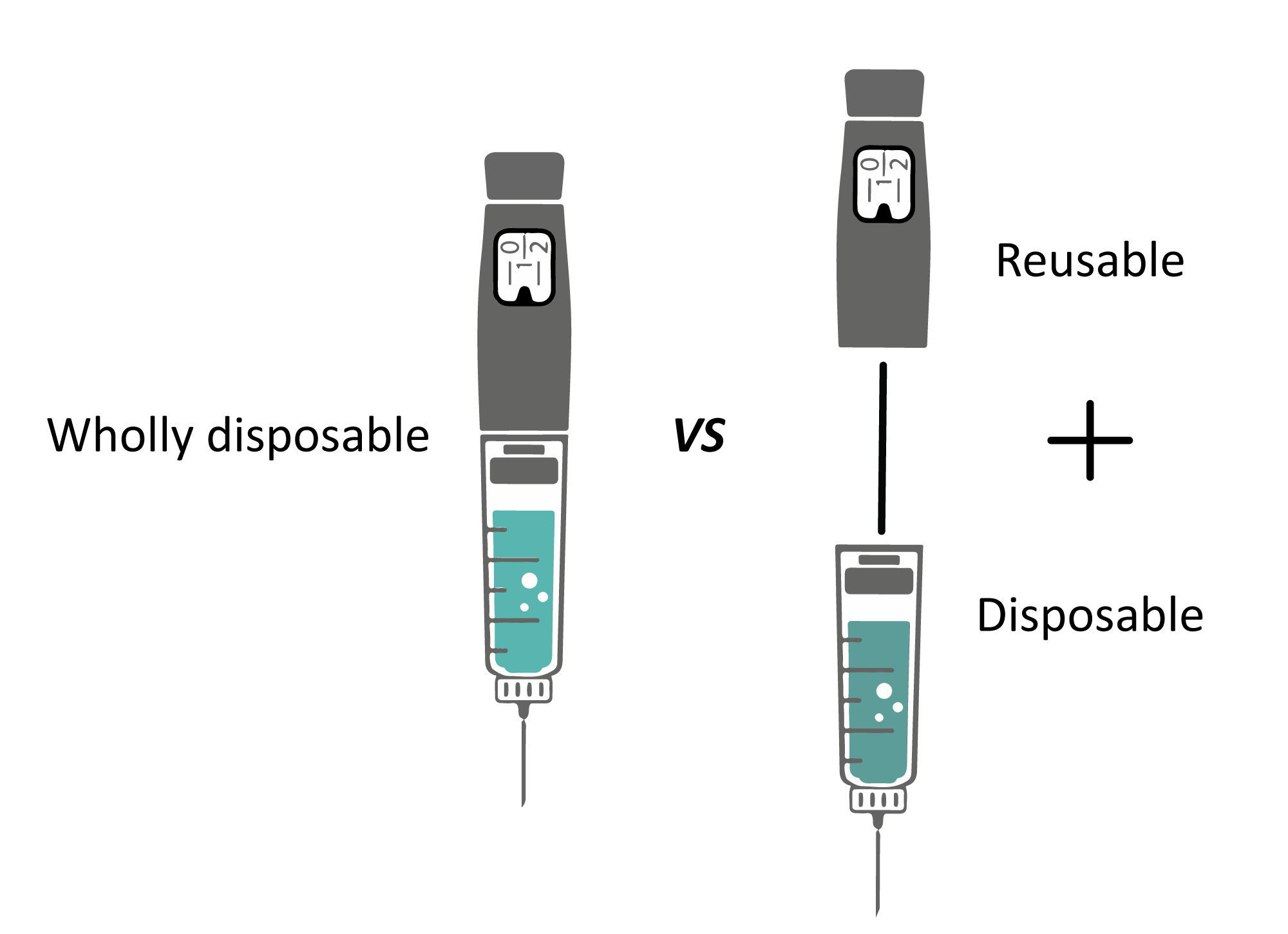
Figure 1: Part reusable an part disposable devices
There seems to be a trend whereby pioneering devices tend to be partly reusable, and then wholly disposable versions appear and take some of the market. Examples include:
Many of the devices Sanner is being asked to develop at the moment may indicate that the pendulum is swinging back towards partly reusable devices. Drivers are likely to include:
Used drug delivery devices create biohazard waste that needs to be incinerated, and typically some plastic waste as well. Pharmaceutical companies and device manufacturers are looking for ways to reduce the waste going to landfill, and one of the strategies is return-to-manufacturer schemes.
GSK ran a return-to-manufacturer scheme for its inhalers from 2011 to 2020. Sources indicate that take-up was not as high as GSK wanted, although more than 2 million inhalers were recycled by the scheme. GSK has said that it “believes there needs to be a focus on a wider, joint-working approach across industry, rather than our own standalone approach.”[2]
Nevertheless, some manufacturers are piloting new schemes, such as:
We can expect to see more recycling schemes being announced in 2022 if these pilots are successful.
Ethylene oxide and gamma irradiation account for the majority of medical device sterilization. However, ethylene oxide has a relatively long cycle time (including aeration time to reduce sterilant concentration) and the sterilant is explosive and carcinogenic.
Gamma radiation can damage materials, turning transparent materials yellow or brown, and crosslinking certain useful engineering polymers like PTFE and PP. Gamma can also damage drugs and electronics, and a global shortage of cobalt-60 is limiting capacity.[5]
There have been some innovations over recent years, such as using nitrogen dioxide (Noxilizer), but it takes time to validate processes, adapt designs for new sterilization methods, and overcome the risk aversion that is pervasive in the pharmaceutical industry. Demand for alternative sterilization methods will persist through 2022 and beyond.
More than at any other time, in 2022 the world recognizes the need for high quality, accessible, and sustainable healthcare. We are likely to see remarkably high levels of investment in vaccines, diagnostics, critical care, personal protective equipment and reducing environmental impact.
Written by Tom Oakley, Sanner and featured in ONdrugDelivery; edited to appear on our site with American writing conventions
[1] “Dry powder inhalation: past, present and future” A. H. de Boera, P. Hagedoorna, M. Hoppentochta, F. Buttinib, F. Grasmeijera and H. W. Frijlinka, EXPERT OPINION ON DRUG DELIVERY, 2017 VOL. 14, NO. 4, 499–512 http://dx.doi.org/10.1080/17425247.2016.1224846
[2] https://pharmaceutical-journal.com/article/news/inhaler-recycling-scheme-that-cut-carbon-emissions-equivalent-to-more-than-8500-cars-is-scrapped
[3] https://pharmaceutical-journal.com/article/news/first-ever-injection-pen-recycling-pilot-launched-in-uk-pharmacies
[4] https://pharmaceutical-journal.com/article/news/chiesi-launches-postal-asthma-inhaler-recycling-scheme