Rely on the pioneer of Desiccant Packaging

For more than 70 years, Sanner has been manufacturing high-quality packaging systems with desiccants for the pharmaceutical, healthcare and diagnostics industries. From integrated desiccants, as in our Sanner effervescent tablet packaging, to desiccant packs such as AdPack®, or capsules such as AdCap®, we have extensive knowledge and experience of what it takes to keep sensitive products in their optimal state.

Sanner is the pioneer in integrated desiccants like silica gel and molecular sieve for pharmaceutical, healthcare and medtech applications. Our desiccant products meet the global requirements, especially those of the European Union,  the US Food and Drug Administration (FDA) and the Chinese NMPA.

Two ways of protecting your product

A desiccant is a substance that can bind water or gases chemically or physically. Common solid desiccants, such as silica gel, bentonite and molecular sieve, physically bind water from the atmosphere by adsorption. Liquid desiccants bind water chemically, through absorption.  

Due to their porosity, solid desiccants have a large specific surface and can bind up to 40% of their own weight in water. 

In addition, many desiccants can be regenerated by heating. The larger the specific surface of solid desiccants, the more water can be bound. In addition, the pore diameter of the desiccants has an influence on which gases can be adsorbed. The larger the pore diameter, the more different gases can be bound by the desiccants. Solid desiccants are divided into microporous (pore radii <1 nm), mesoporous (pore radii 1-25 nm) and macroporous (pore radii >25 nm) structures. 

At Sanner, we use two types of solid desiccants: silica gel and molecular sieves. Both types of desiccant are hygroscopic, i.e. they adsorb moisture or water vapor and keep it away from the packaged contents. 

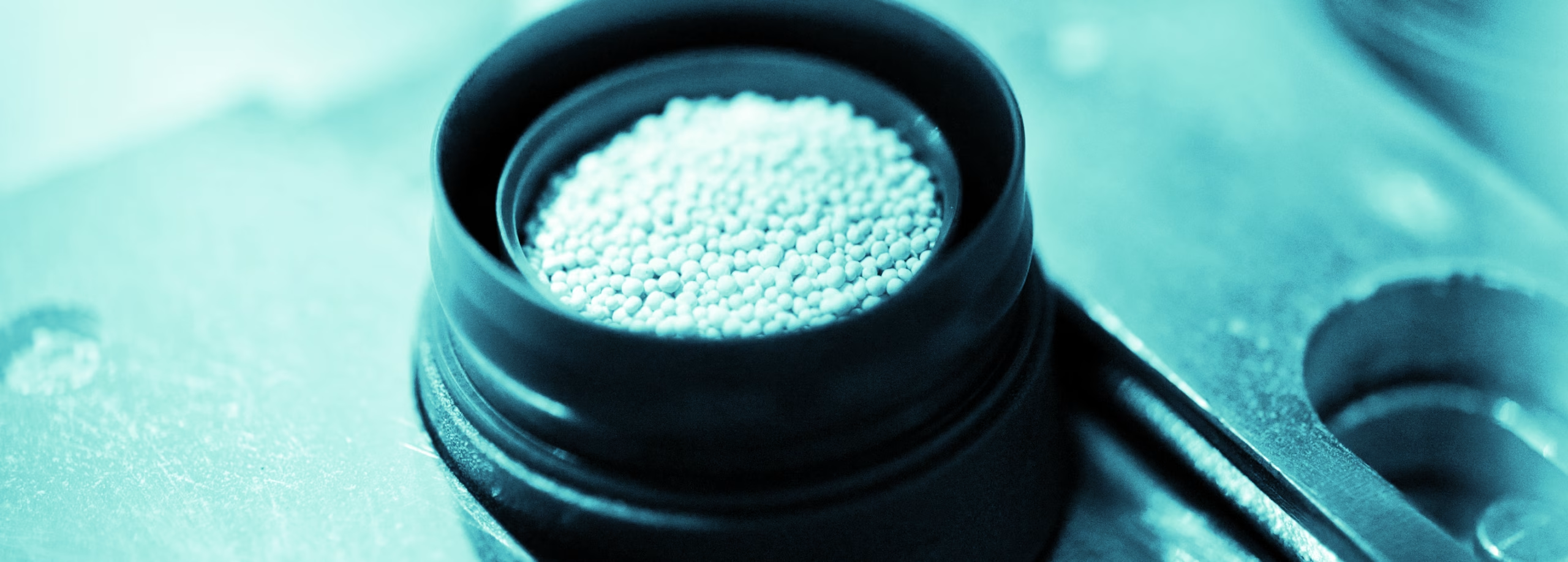
Silica gel is a colorless and odorless drying agent, which is usually processed into a pearl-shaped structure. 

The surface of silica gel is covered with silanol groups to which water molecules can bind by means of hydrogen bridge bonds. Silica gel is resistant to most substances except strong alkalis and hydrofluoric acid. It does not develop vapors and does not react with metal. The water absorption capacity of silica gel increases with relative ambient humidity. However, silica gel only adsorbs water from an ambient relative humidity of about 10%. Silica gel is the more cost-effective type of desiccant by some distance, and ideal if a certain residual moisture (approx. 10%) is desired or permissible in the container (e.g. for gelatin capsules). 

The second type of desiccant used by Sanner is molecular sieve. Molecular sieves are aluminum silicates and can be obtained by decomposition or synthesis. Like silica gel, molecular sieves are processed into powder or bead form. Unlike silica gel, molecular sieves can bind water molecules regardless of the ambient humidity. Therefore, Sanner uses molecular sieves especially when drying is required under a relative humidity of 10%. Nevertheless, the adsorption capacity of molecular sieves increases with rising ambient humidity. 

In principle, both types of desiccant always remain dry to the touch after saturation with water and can be regenerated by heating, saving resources. 

Desiccants are mainly produced in Asia and some are refined in Europe. 

The starting material of silica gel – usually sodium silicate – is enriched with water to obtain a silicate solution. The addition of an acid, such as sulfuric acid, creates hydrogel by splitting off water. In the next production step, the reaction and solution water is washed out, causing the silicic acid to coagulate and form the silica gel in the following drying step. The characteristics of silica gel can be modified by varying the washing process. The pore diameter is mainly influenced by the washing process. 

In summary, the silica gel is synthesized by polycondensation of the hydrogel and a subsequent washing process. Finally, the silica gel is dried in a temperature range of 100 – 400 °C. 

Sodium silicates or aluminum salts can also be used as starting material for molecular sieves. Aqueous solutions containing silicon and aluminum compounds are obtained from these minerals and water. As with silica gel, polycondensation is a step in the synthetic production of molecular sieves. During the crystallization of molecular sieve, water molecules bind physically in the pores of the desiccant. These are removed by heating.

Each closed space, including pharmaceutical packaging, has its own climate containing water vapor.
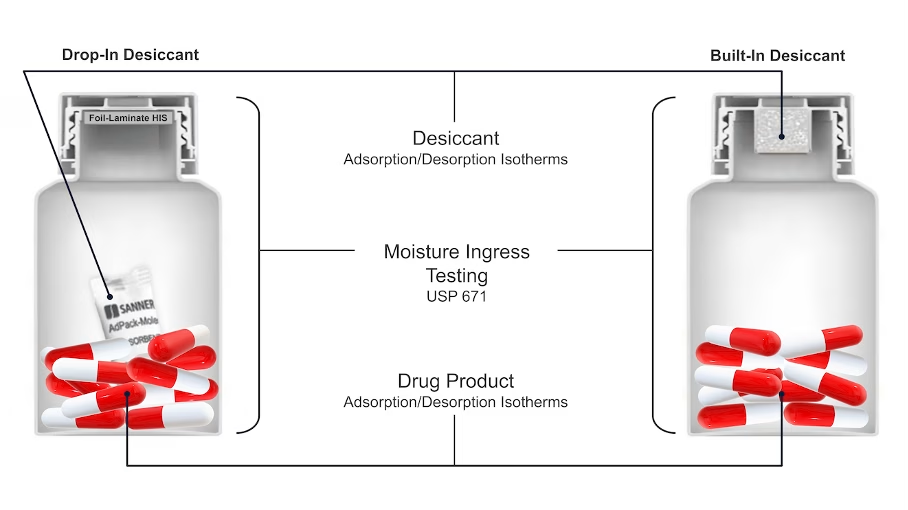
Desiccants are used to reduce moisture in packaging with different procedures. In the case of effervescent tablets, for example, desiccant closures are used to close the tablet tube. 

Furthermore, desiccants can be used as capsules or sachets, which are added to bottles or medical products. Also, various closure formats such as screw caps for bottles are used. 

Alternatively, a desiccant chamber can be developed within the packaging to provide in-situ moisture protection. 

A barrier layer (plastic packaging) separates the air inside the packaging along with the packaged goods and the desiccant from the outside climate. This creates a so-called microclimate. It is important that the shell is as impermeable to water vapor as possible. The desiccant dries the trapped air so that no moisture damage is caused to the packaged product.

Adsorption is a physical process where certain molecules bind to the surface of another suitable substance and accumulate there. The desiccants used by Sanner are specially designed for enrichment with water molecules. 

This requires the largest possible specific surface of the desiccant so that as many water molecules as possible can bind to the desiccant.

Relative humidity (RH) is the measurement of the amount of moisture in the air at a given temperature. 

It is defined as follows for a given volume of air: 

absolute moisture content in the air volume
––––––––––––––––––––––––––––––––––––     x 100%
maximum possible moisture content 


There is no defined critical value for relative humidity because each product reacts differently to moisture. 

However, the value of approx. 30% relative humidity serves as a rough guide, as many moisture-related problems no longer occur below this value. 

Customers’ product requirements for moisture protection or moisture regulation help to determine the suitable desiccant. If the product or packaged goods require a very low moisture content, the use of molecular sieves is appropriate. If the products are less susceptible to moisture, we generally recommend silica gel. 

For decades, we at Sanner have been the experts who determine the appropriate type and quantity based on various influencing factors with our Atmo Guard System® service to ensure that your product is safely packed and fulfills the required shelf-life. 

The shelf-life depends on the climatic filling conditions, desiccant type and quantity, and the water vapor permeability of the packaging, i.e. the tightness of the system and the material used, as well as the ambient climate. Most products must have a shelf-life of 2 years. The above-mentioned parameters must be considered when designing the desiccant type and quantity in order to ensure that the target humidity level within the packaging is not exceeded throughout the shelf-life. 

The optimal design of these parameters makes it possible to precisely determine the required water vapor absorption capacity so as not to exceed a specified humidity level within a closed package during storage. 

Sanner’s Quality by Design (QbD)-based Atmo Guard System® program can quickly predict moisture management outcomes of pharmaceutical, nutraceutical, and diagnostic products in primary packaging to promote their chemical and physical stability. 

The Sanner Atmo Guard System® for desiccated packaging integrates the following parameters to determine an appropriate moisture management solution: 

  • Chemical and physical pathways of drug, nutraceutical, or diagnostic product degradation 
  • Free moisture in the product 
  • Adsorption and desorption isotherms for the product 
  • Adsorption and desorption isotherms for the desiccant or moisture regulator 
  • Moisture ingress into primary packaging 
  • Initial package headspace relative humidity 
  • Free moisture from cotton or rayon used in bottle packaging 

Sanner desiccant closures, capsules, sachets and packaging with integrated desiccant are usually packed in PE bags with a cardboard box. In accordance with GMP recommendations, our products should be stored in a clean and dry place, in the unopened original packaging and at temperatures between 10°C and 30°C, in order to ensure a shelf-life of 6 months until processing.  

In some cases, aluminum composite bags can be chosen to achieve a shelf-life of 3 years. 

What would happen if I did not protect my medicine from moisture?  

Moisture causes a whole range of undesirable effects. Therefore, you should not neglect the appropriate protection for your moisture-prone products. 

Here are some of the more common negative effects associated with excessive moisture: 

  • Incorrect result displayed on blood and urine test strips 
  • Corrosion of metallic surfaces, e.g. of medical devices 
  • Reduced effectiveness of drugs 
  • Unpleasant smell 
  • Fungal infestation of tablets 
  • Discoloration of tablets 
  • Chemical changes 
  • Smudged tablet surfaces and no longer legible imprint 

To be on the safe side, please consult our experts of the Sanner Atmo Guard System® Service if your product requires an optimum solution for moisture regulation. 

Contact

Get in touch with our team today