


Secteurs
Solutions
Capacités
À propos
Perspectives
Secteurs
Solutions
Capacités
À propos
Perspectives
« Most of us understand that innovation is enormously important. It’s the only insurance against irrelevance »
Gary Hamel
« Innovation requires the ability to collaborate and share ideas »
Bill Gates
Innovation is critical to all businesses. We live in a knowledge-driven economy and, especially in medical devices and drug delivery, giving patients the benefits of new and better products is clearly beneficial for all concerned: patients, payers, healthcare authorities, pharmaceutical companies, and medical device manufacturers.
Collaboration is more important than ever to manage technical risks and build on the best talent available throughout the development process. But there are very few sources of good information on how to find the best companies to collaborate with. This article gives an insight based on many years of experience in the field.
We hope that it is helpful and perhaps even interesting!
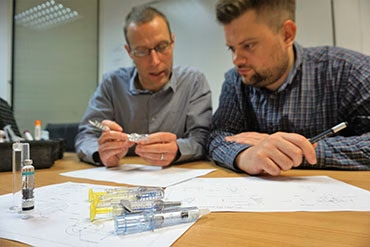
Collaborating with external experts works best when you and the relevant stakeholders within your organization (particularly the development team) see the value.
In some cases, there’s reluctance to collaborate, but it can lead to projects not working very well due to the limits of the skills, capability and equipment of your own development team.
In other cases, where you just want more people in your office or labs to work under your own supervision, a lone contractor may be more appropriate than an external R&D partner. Using contractors is a different mind set from working with external R&D companies because typically the latter will take on leadership to overcome hurdles in the way, and display a greater degree of autonomy on reaching a solution.
It is misleading to compare quotes to salaries. This is a common temptation, but when you consider the salary of yourself or your staff, you are not including pension, bonuses, premises, training, recruitment costs, computers, software licenses, under-utilization, lab equipment, lab space, insurance, accounting and legal support, and so on. If you add up those things for your internal team, you will find the market rate for R&D work. The quotes from potential partners should match this: they should be the market rate after all. When coupled with rapid and reliable progress on solving a valuable problem, the cost-effectiveness should be clear.
If you and your team do see the value in an external collaboration, move to Step 2…
What is it that you need? This will inform what you’re looking for in an external partner.
When it comes to specifying the size and shape of a project, there are 3 competing factors:
Typically, you can optimize a project for any 2 of the above.
Reputation is everything. A really good innovation partner will have a good reputation which others in your field will know about. If you don’t know who to ask, maybe former colleagues at another company can help. You can always get in touch and ask us!
You may already know that a company’s name being well-known correlates strongly with its marketing budget, and not necessarily with the quality of its work.
It is about the people, not the brands. We have found that the most important ingredient in successful development projects is the quality of the people. Two qualities stand out as being vital:
Really good engineers and scientists will be able to use the right technique and equipment even if they have not used exactly the same things before. On the other hand, it could be folly to expect mediocre engineers and scientists to develop market-leading high performance, usable and safe products, or fix non-trivial technical problems.Perhaps ask yourself this provocative question: « How many opportunities do I have to get this project right? »
There is sometimes a downside to really capable people: they can be arrogant and therefore not so good to work with. The best way to assess this is Step 4…
It is worth spending the time to speak with potential partners because a website or word-of-mouth cannot give the full picture about the quality and attitude of the people actually working at the potential partner company. By definition, case studies on websites will be very old because they have to be outside of confidentiality terms. Therefore, the people that developed those devices might not be working at that company anyway.
Talking with the company can help you assess:
Here is a list of common pitfalls to watch for:
This may be the hardest step. There are any number of approaches to come to a decision…
Factors such as trust in the people, and your belief in their ability to deliver, are hugely important. Therefore, a spreadsheet of metrics (beloved by procurement departments) is probably not the best way to decide between potential partners.
Perhaps the best way is to think about which partner you would prefer to have a long-term business relationship with, and see if their match to the current project need is good enough.
If this post has teased any thoughts or questions, please get in touch. We would love to hear from you.