

Industries
Solutions
Capabilities
About
Insights
At the start of 2025, the drug delivery device industry is larger and more innovative than ever. In the “Drug Delivery Trends for 2024” article in ONdrugDelivery’s January 2024 issue one year ago,(1) we identified five key trends for the past year:
Sales of weight management drugs, led by glucagon-like peptide-1s (GLP-1s) such as Wegovy (semaglutide, Novo Nordisk) and Zepbound (tirzepatide, Eli Lilly), have indeed increased substantially from around US$40 billion (£31.8 billion) in 2023 to around $53 billion in 2024. Growth is expected to continue in the region of 16% to 18% annually.(2) The $16.5 billion acquisition of Catalent by Novo Holdings (Dartford, UK) in February 2024 caused shockwaves through the drug delivery industry as fill-finish and injection device manufacturing capacity became saturated.(3) This trend shows no signs of slowing but will change significantly as semaglutide’s core patents expire in various countries in 2026.
Closed-loop insulin systems continue to innovate, with the Omnipod 5 (Insulet, Acton, MA, US) pump able to integrate with the FreeStyle Libre 2 (Abbott Diabetes Care, Chicago, IL, US) or Dexcom G6 (DexCom, San Diego, CA, US) continuous glucose sensors4 and the t:slim X2 (Tandem Diabetes, San Diego, CA, US) integrating with the FreeStyle Libre 2.5.
Meanwhile, new options for large-volume injections continue to emerge, such as 5 mL autoinjectors. Additional ophthalmic injector development demand continues to be high, but the innovative projects in this area remain confidential.
Finally, anecdotal evidence suggests that new development budgets increased substantially in 2024. As predicted, many major pharmaceutical and medical device companies emerged from their corrections after the significant investments made in the industry during the covid-19 pandemic, multinational supply chains adjusted to new geopolitical realities and interest rates reduced throughout the year, thus freeing up capital for investment.
Many people think of EpiPen from Viatris when emergency medication is mentioned. EpiPen contains adrenaline (epinephrine) to treat anaphylaxis, which can be life threatening. However, some patients and caregivers delay or do not administer treatment in an emergency due to fear of the needle, lack of portability or, for untrained users, fear of giving an injection, among other reasons.(6) The first nasal adrenaline for anaphylaxis was approved in Europe in June 2024, and the US in August 2024.(7) The product is called EURneffy in Europe and neffy in the US (ARS Pharmaceuticals, San Diego, CA, US). We look forward to other emergency drugs being delivered through new administration routes or using new and improved delivery devices.
Regulatory guidance for emergency combination products is evolving. In April 2020, the US FDA released draft guidance on “Technical Considerations for Demonstrating Reliability of Emergency-Use Injectors Submitted under a BLA, NDA or ANDA”. This draft guidance is being used for developing devices that are injectors or use different routes of administration.
The draft guidance contains the “5 Nines” rule, wherein it “recommends that emergency-use injectors include design control specifications for successful injection reliability of 99.999% with a 95% level of confidence.” If taken literally, this would mean that a development program would have to test nearly 300,000 devices with zero failures. Emergency devices are typically single use, so a six-figure number of tests is commercially impractical. Therefore, advanced device development and statistical expertise are needed to justify confidence to the 5 Nines level.
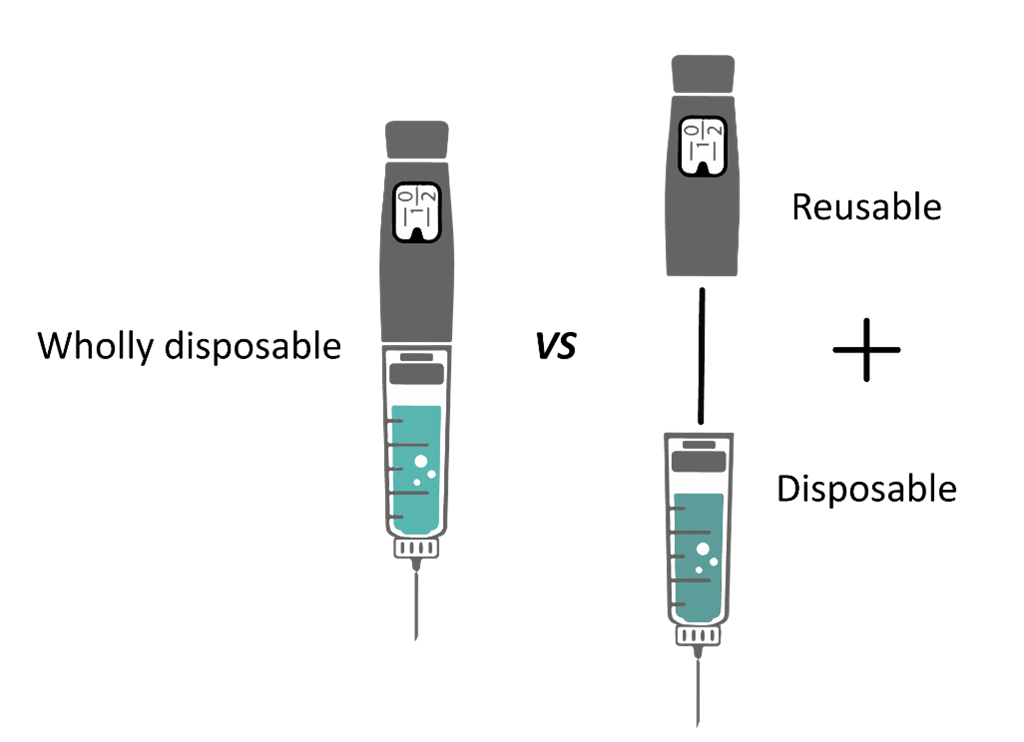
Many drug delivery devices can be developed as either disposable or part-reusable (Figure 1). In our “Drug Delivery Device Trends for 2022” article,(8) we identified a trend whereby pioneering devices tend to be partly reusable, and then wholly disposable versions appear and take some of the market. Many of the devices in development indicate that there is renewed interest in reusable devices. Drivers for this trend are likely to include the following:
Example reusable autoinjectors that have been announced recently include:
Reusable injection devices from earlier years include easypod/RebiSmart from Merck Group, AutoTouch from Amgen, and ava from UCB Biopharma (Brussels, Belgium).
Development of new biologics, particularly monoclonal antibodies, is leading to demand for injection devices capable of handling increased volumes and viscosities. Most commercial autoinjectors are driven by a mechanical (typically stainless steel) spring. However, compressed or liquefied gas canisters can provide higher energy densities than springs. As such, several companies have developed gas-powered autoinjectors, with current examples including:
This is not an exhaustive list of the gas-powered injectors in development, and several have ceased development, such as Syrina by Bespak. The clear trend is that many device companies are betting on gas power as their future platform for high-viscosity and/or high-volume injections.
Patient adherence remains a critical challenge in the management of chronic conditions, with injection site pain (ISP) playing a significant role in non-compliance.(9) ISP is a multifaceted issue influenced by environmental factors,10 patient physiology, and the characteristics of formulations and delivery devices. Formulations often include excipients – such as buffering agents, tonicity adjusters, bulking agents, surfactants and preservatives – essential for maintaining the stability of complex and fragile therapeutics. However, these excipients may inadvertently contribute to ISP. Similarly, device characteristics, including needle geometry and delivery rate, significantly impact the level of pain perceived by patients during administration. Addressing these factors is critical for improving patient experience and adherence.
The introduction of innovative adjuvants, such as hyaluronidase, represents a breakthrough in reducing ISP, particularly for larger-volume formulations. These adjuvants facilitate more tolerable delivery and their adoption has gained momentum, including the FDA’s recent approval of VYVGART Hytrulo by Argenx (Boston, MA, US) in 2024. This development sets the stage for broader use of adjuvants in 2025 and beyond.(11)
Autoinjectors, such as the YpsoMate 2.25 (Ypsomed), will use syringes featuring short, ultra-thin needles specifically designed for high-viscosity formulations,(12) with the announcement of a collaboration with BD on integration of the Neopak™ XtraFlow™ system.(13) This trend is expected to expand into broader applications and other primary packaging systems intended for subcutaneous delivery.
There has also been a sustained adoption of on-body devices that, among other things, achieve slow injections, which inherently limits ISP:
Advances in injection technologies, from innovative adjuvants to cutting-edge device designs, can reduce ISP and thereby reduce one of the key barriers to higher patient adherence. We expect an increased adoption of new technologies through 2025 across a broader range of formulations and therapeutic areas.
SUMMARY
The weight-management drug market continues to boom and new closed-loop insulin systems continue to come to market. There has also been progress in large-volume injectors and ophthalmic injectors. There are signals that the development budgets for drug delivery devices increased in 2024 over 2023 as predicted.
Those trends are likely to continue and, to those, we have added the following predictions for 2025:
Written by Tom Oakley and Alex Vasiev and featured in OnDrug Delivery.
REFERENCES