

行业
解决方案
实力
关于
洞察

行业
解决方案
实力
关于
洞察

As humans, we are not perfect. We make mistakes, poor judgments, and errors. But there are good reasons why we behave as we do, for example:
“I just got off a flight from the US, so I am exhausted, jet-lagged and making rash decisions.”
We also have limitations:
If we do not understand who our user is and the environment in which the product is used, it can be difficult to critique our own designs.
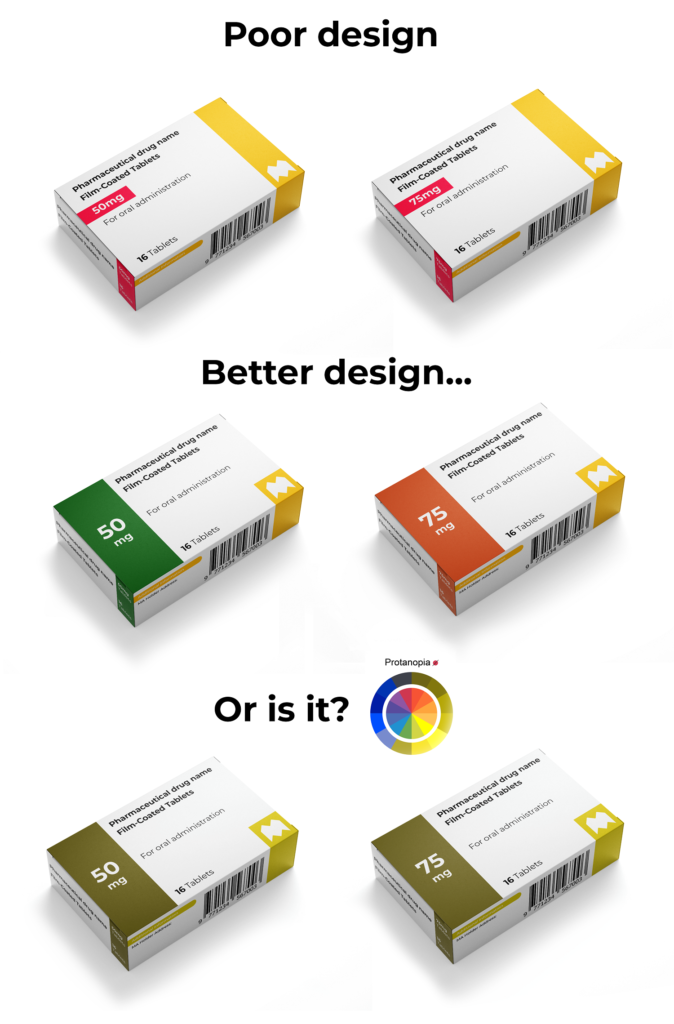
Imagine we were designing a medication packaging for a patient who takes multiple different oral chemotherapy drugs depending on the stage of their regime. In the first set of images, the 50mg and 75mg boxes look very similar, making it difficult to recognize the difference if you are in a rush or tired or have a visual impairment.
The second set of images shows a better design where the concentrations are illustrated in a larger font and have different color backgrounds. However, if we knew that 8% of men have some form of red-green color deficiency, we might want to rethink our color choices. The final images in the picture show what a person with protanopia would see: there is no difference in colors. Photoshop has a built-in proof viewing option for protanopia and deuteranopia color blindness.
Depending on the device you may have several users who interact with the product, and they may have roles, e.g. parent, caregiver, maintenance or healthcare practitioner (HCP).
The FDA views user populations as distinct when their characteristics would likely affect their interactions with the device or when the tasks, they perform on the device would be different. For example, some devices will have users in different age categories (pediatric, adolescent, adult, or geriatric) or users in different professional categories (e.g., health care provider, lay user).
Below is a list of user characteristics you may want to investigate before recruiting user groups for testing.
Checklist of user characteristics to investigate:
It is important to think about where your product is going to be stored, used, and disposed of because it could influence how the user interacts with it. For example, the characteristics of the room such as the lighting may make a digital user interface unreadable. Additionally, there may be other items in the room that are similar to the one you are testing, making it difficult to identify the correct one, e.g different cartridges of different concentrations.
You may consider conducting ethnographic research if the product’s interactions rely heavily on the environment it is placed in. The study technique involves observing people in their natural environment to find out how they interact with the world around them.
Checklist of characteristics of the environment to investigate:
To evaluate a design, we must conduct user testing to discover user feedback and find causes for use errors. If you know a design decision will be made based on the user interface and it will significantly impact part of your development, it is more cost and time-effective to start user testing prior to that design decision. It is recommended to conduct a series of formative user tests (at least 2-3 for medical devices) and it can be more productive to conduct small-scale tests rather than fewer large-scale tests.
User studies are a vital part of making sure that your products are successful on the market and used effectively by all the relevant users. By designing your product and packaging with a deep understanding of the user, you can instill confidence that you are developing the right product to meet user needs.